
 Deutsch
 Français
 Español











Description
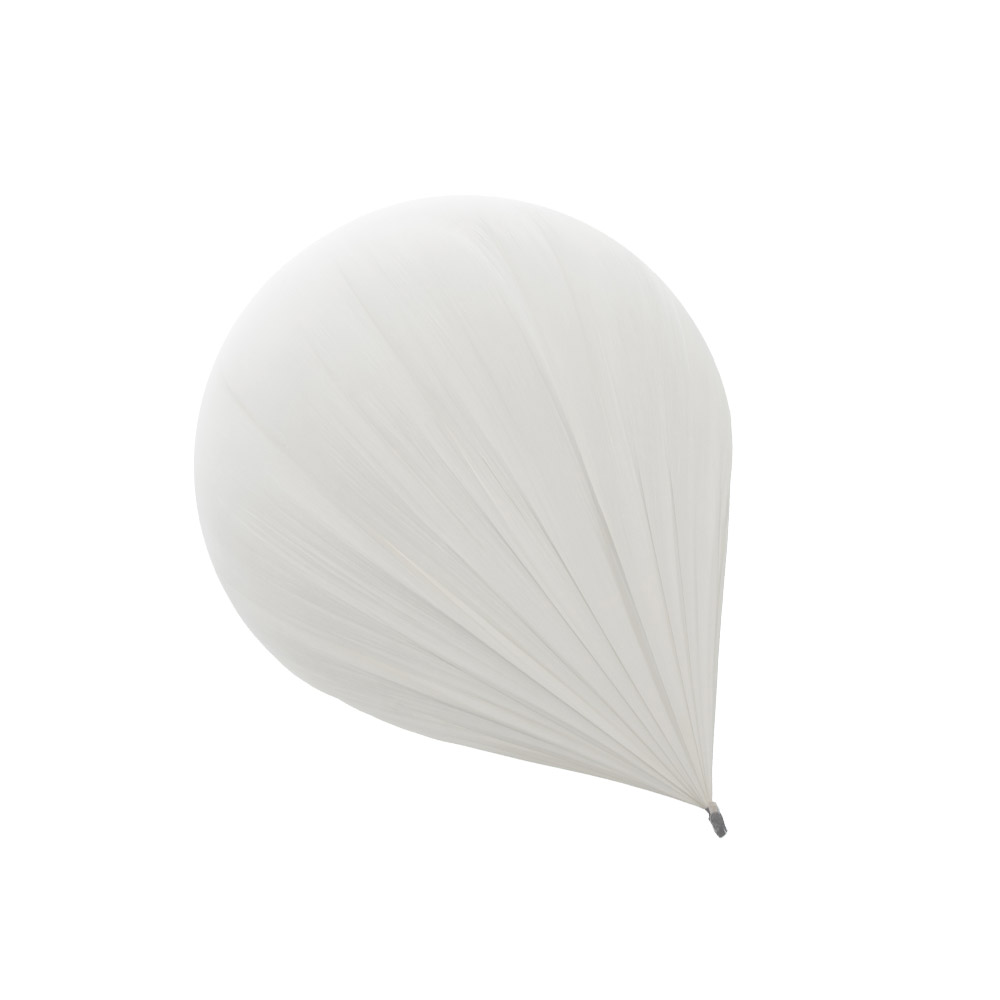
The Pilot Balloon is a small, elastic latex balloon for very light payloads of up to 30 g (1.1 oz). It weighs 30 g itself, reaches an average burst altitude of around 11,500 m (7.1 mi) and rises at about 3 to 4 m/s. Thanks to its red signal color, it remains clearly visible in the sky for a long time. This makes it the classic tool for determining wind and cloud height, and an affordable solution for low-altitude experiments. You can calculate how much helium you need with our free Helium Calculator.
Applications of the Pilot Balloon
Measuring wind
Pilot balloons have long been used in meteorology to determine wind direction and wind speed at different altitudes. After launch, the balloon is followed with the naked eye, binoculars or a theodolite: from its drift and the known ascent rate, you can determine how strongly and from which direction the wind is blowing at each altitude. Before a large stratospheric flight, this is a simple way to assess the wind conditions at the launch site.
Determining cloud height
The height of the cloud base can also be measured with a pilot balloon. You time how long it takes from launch until the balloon disappears into the cloud and multiply that by the ascent rate. For example, if it disappears after five minutes at 3 m/s, the cloud base is at about 900 m (2,950 ft). This also makes the Pilot Balloon interesting for physics or geography classes.
Amateur radio
Radio amateurs use the Pilot Balloon for very light radio projects, such as small APRS transmitters. The important thing is that the transmitter, antenna, power supply and mounting together weigh no more than 30 g. For heavier radiosondes, we recommend the Weather Balloon 200.
Schoolyard experiments and art projects
Raised on a cord, the Pilot Balloon is suitable for low-cost experiments at low altitude, for example to measure temperature or pressure differences with a very light sensor. The red balloon is also popular for art projects and installations. For tethered launches, we recommend our tear-resistant Special Cord.
Which balloon suits your payload?
The Pilot Balloon is the right choice for wind and cloud measurements and for payloads of up to 30 g. For radiosondes and lightweight measuring instruments of up to 200 g that are meant to reach the stratosphere, the Weather Balloon 200 is the right fit. If you want to record videos or take photos from the stratosphere, we recommend the Weather Balloon 800 for a camera probe of up to 800 g; for heavier payloads, our bestseller, the Weather Balloon 1600, as well as the Weather Balloon 2000 and Weather Balloon 3000.
Planning a large stratospheric mission? The Weather Balloon Kit contains all the equipment except the helium. With the configurator, you can put together your own custom kit.
Datasheet Weather Balloon (PDF)
Note: Due to the minimal carrying weight, pilot balloons are not suitable for stratospheric flights! They are only used for meteorological purposes or for experiments with a minimum weight (max. 30g) in the school playground.



















Salsero –
Habe den Ballon für eine Vaisala Radiosonde genutzt
K.H. –
Als Amateurfunker haben wir den Ballon für einen kleinen APRS-Sender genutzt. Hat alles prima geklappt.