Question over Question – here are the answers!
A stratosphere flight is an extraordinary school project and more than unusual. During the implementation of this STEM school project on the edge of the universe, questions may occur. To simplify the preparation and the implementation as much as possible, we have collected the most frequently asked questions:
Where can I get the ascent permission for the weather balloon?
You have to apply for the launch of your weather balloon with the authorities. For many countries we have not only the direct contact details to the authorities, but even the tools for registration or the application forms linked. Click here to register your weather balloon!
What insurance is needed to start a weather balloon?
To apply for your weather balloon launch, you will need aviation liability insurance to cover personal injury and property damage. You can purchase weather balloon insurance using the following tool: Weather Balloon Insurance from AXA.
How do I set up the project week?
If the stratosphere flight should be completed within a project week at the school, we offer an overview of how a four-day school project week can be designed. Basically, the entire project is individually scalable in scope and content.
How much prior knowledge do your students need?
The students do not need any prior knowledge. All content needed to complete the project can be developed directly in the project week or lesson series.
Which experiments are suitable?
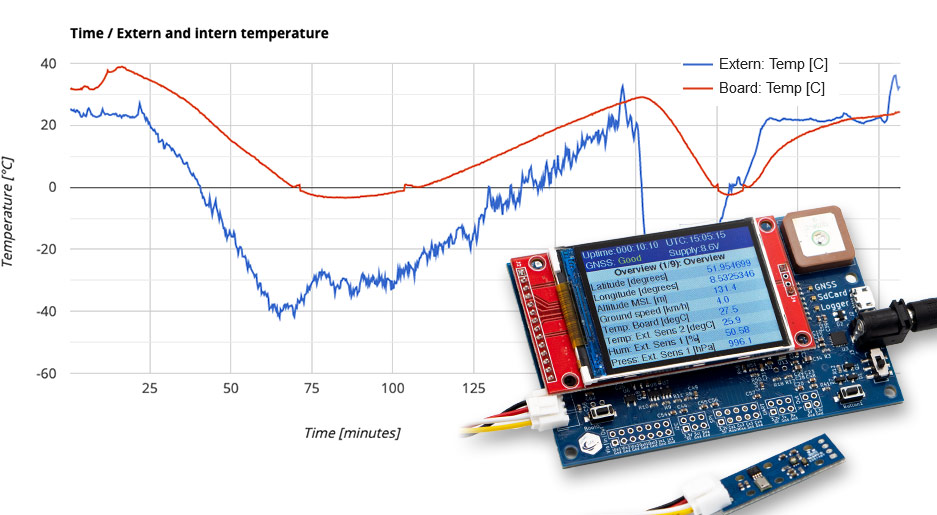
There are many exciting and meaningful experiments that can be carried out in the extreme conditions of the stratosphere with temperatures as low as -65°C (-85 °F) and a low ambient pressure. Ultimately, there are experiments for every age range. What would you like to explore in the stratosphere, to motivate the participants even more?
Here we would like to give a small overview of exciting experiments. Since the school project on the edge of the universe is suitable for every age group and suitable experiments can be found, here is a small selection:
- How are the air pressure, humidity, GPS position and thus the altitude, temperature in the stratosphere changing?
Liquid experiments: How do different substances behave in this extreme environment?
- UV radiation: What effect does UV radiation have on fluorescent substances?
- Ozone: Is the ozone layer still present above the take-off area?
- Plants: How do plants react to the extreme cold? For example, does cress grow after a flight to the edge of space? How is the comparison subject developing on earth?
- Balloon/ Foam Kisses: How do these objects behave in a harsh environment? What observations can be made on the video recordings?
- Radiation: How does the radiation change?
How much preparation time do I need as a teacher for this project?
Our equipment includes detailed instructions and are illustrated with pictures. The weather balloon kit, which contains all the equipment for a successful mission to the stratosphere, contains a comprehensive manual with numerous tips & tricks. Furthermore, our tutorial page offers a lot of information to prepare you as well as possible for the project. Furthermore, the project should be developed by the students, for example the construction of the probe, etc. So, the amount of time need, is very manageable, you need to read the instructions and look at the examples of other schools on our website. Many teachers also get together to team up for the project, for example with a teacher with a physics and a biology background. We want to make the project as popular as possible, so it is important to us that the project is as simple as possible.
How much time is needed for this project?
The STEM school project is individually scalable in terms of content and scope. Many teachers carry out the projects as part of a project week. Just as many teachers implement the stratosphere flight into their lessons so that, for example, certain experiments or theories are worked out, which are then examined with the help of a stratosphere flight. Furthermore, many schools use the stratosphere flight for an AG or engage the senior classes with different tasks of the project. Thus, the project can be treated within the framework of a weekend crash course, a project week, or even a series of lessons which can last several weeks.
There are no limits to this project, even beyond natural science subjects: for example, the German course can make a photo story or write a newspaper article and compare it with the later published articles by the local press.
Can I do is project with the whole class?
The project offers many possibilities. It is no problem at all to give the entire class suitable tasks for everyone. For example, several probes can be developed during the construction of the probe and then the students can decide which probe will fly to the stratosphere. Furthermore, expert groups can be formed for specific areas such as for construction, localization, experiments and documentation of the mission.
Where can I get helium/balloon gas?
Most schools don’t even know that there is usually helium/balloon gas in the chemistry collection. So, by the way, is the pressure reducer needed to fill the helium/balloon gas. If this is not the case, the cheapest option is to purchase balloon gas from hardware store chains. Alternatively, gas distributors such as Linde or Air Liquide can be contacted, although the price is usually significantly higher. A suitable pressure reducer for helium / balloon gas can be purchased from our online store.
Which rooms are needed for the project?
For the accomplishment of the school project on the edge of the universe, there is no special equipment needed. Basically, every simple room can be used for the project. The optimal rooms would be a physics/workroom or a room with access to computers with internet so that further research can be ensured.
What would be the best time to launch the weather balloon?
We launch our weather balloons categorical only in the morning. Optimally, we combine the lift off with the first big break and draw attention to the project with announcements through the loudspeaker made by the students, so that the whole school has the opportunity to gather at our starting point. Furthermore, starting in the morning makes more sense because you never know how time-consuming the recovery might be.
What would be an optimal starting location?
Most schoolyards can be used as a starting location without any problems. If the surrounding buildings are too high or trees may turn out as a security issue, the first place to look at as an alternative would be the sports field. There should be enough space, to get the weather balloon started without any issues.
Should I inform the local media about my school project?
Absolutely! The local media is always happy about adventurous projects, as our trip to space, they will love to report about the event. And on the upside, they will produce not only attention, but they also produce high impact movies and photos.
Often the school project on the edge of the universe is additionally accompanied through the local TV stations. Therefore, just give your local TV and radio stations a call. Furthermore, the headmaster will be happy about the publicity of his or her school. Enclosed is a link to the press section of the school projects.
What happens in bad weather conditions? Do I have to reschedule the start?
If your starting location is in Germany, the official requirement by law says that starting is only permitted if the cloud layer does not cover more than 4/8 of the sky. Which means you might have to postpone your start due to weather conditions. Online tools such as weather Online or Wetter.com provide good forecast information about the expected sky layer. For this reason, you should name alternative starting dates, like the day after or a week later, directly at the registration to be one the save side. Then, if the weather condition should not be suitable on the scheduled day, a start on an alternative day is possible without any bigger changes. The authorities in other countries have partly deviating regulations, however, they will communicate their regulations when issuing the ascent permit.
How can I organize the money for the equipment?
In Germany,many schools are supported through a development association. Furthermore, there are different associations such as the Association of German Engineers (VDI) or the German Physical Society (DPG), which finance school projects as well. Many schools collect additional funds through e.g. selling waffles in the breaks, or they acquire local sponsors e.g. the local savings bank. In addition, it is always possible to ask for donations in kind or sell an advertising space on the probe, which works best, if you sent invitations to your local tv stations and newspapers.
Do I need teaching materials for the school project?
Whe have spoken to more than hundred teachers about the school project „on the edge of the universe“ and we offer teacher training as well. With all our experience, we can assure you depending on the teacher and school the project differs considerably. Every teacher has a different idea of the implementation and the needs for a stratosphere project. In this respect, no concrete documents for the school project on the edge of the universe are necessary.
Which formal documents are needed for the project?
– Ascending of the weather balloon for the weather balloon: Weather Balloon Registration Aviation owner liability insurance (e.g. from the alliance insurance)
– Approval of the property owner: Is a requirement for the ascent approval. A letter from the school headmaster, with a signature, is sufficient here.
– Photo permission: Many photos will be taken during the whole project. Especially during the stratosphere mission. Therefore, a permission from the parents should be obtained, that the participants may be photographed during the project and the photos can be used for the school website afterward.
What do I do with students who are more comfortable with their tasks during group works?
Some students will finish the given tasks way ahead of the rest of the group. If this is the case, they could do further research on the internet, or help the other groups in their process.
How do I motivate the parents to help with recovery of the balloon and transport participants?
The participants will be so excited about the project and the possibility to take their own space-based photos, that they will automatically talk to their parents and relatives at home, and in most cases, the interest for this school project will quickly jump to the parents on its own. In the majority of school projects that we have carried out, we have found enough parents which supported the project and drove with us to the recovery, in spite of that is was during the week. Sometimes even some cars were completely full of only parents. You can announce the recovery and the request for escorting by the parent’s weeks ahead, but from our own experience, the carpooling will only arise during the project.
If there are not enough or no parents to accompany the recovery, the participants should return to the “normal” class.
How do I organize the trip to the landing site or salvage?
Basically, the approximate landing site can be predicted using the flight prediction software, in a range from 5 to 10 kilometers. This calculation should be made on the starting day to be exact, if possible. After the weather balloon has been started, all participants should join a WhatsApp group (or a similar messaging group) to communicate about the salvage and give the students which remained at school an opportunity to be part of the salvage. Furthermore, the participants should search for a suitable waiting area via Google maps, such as parking lots of supermarkets etc. The address should be provided to the participants beforehand so that the drivers don’t have to drive in a convoy and can meet at the designated place. Furthermore, the flight route prediction has the advantage that when landing and the exact transmission of the position data by the GPS tracker occurs one is already near the landing site. After the probe has landed, which takes roundabout three hours, all participants can drive directly to the landing site to recover the spectacular cargo.
What happens if I cannot get to the probe? What are to options?
In most cases, the probe will land,at least in Germany, on a field or on arable land. Approximately 30% of the area of Germany is covered with forest. If the probe lands on top of a tree, it can be fished with the help of long branches. As basic equipment, we recommend to take a variety of tools, ropes, and adhesive tape. So that branches can be connected to each other if necessary. Furthermore, ropes/slings can be built on site to try to retrieve the probe. If all trys fail, for example, the local volunteer fire departments support schools for their project for free. Alternatively, there are tree climbers available on the internet who “rescue” probes from tress after work. Always a good idea is, to place your contact details on the outside of the probe so that a potential finder can contact you directly.
How do I distribute the video data afterward?
The camera normally records the entire ascent to the stratosphere. The file collection can be up to 60 GB big. So it would be a good idea to bring an external hard drive along, normally there are enough enthusiastic students which will produce a movie from the raw material. This video can be placed on the school’s website and be downloaded by the participants of the project.
How do I best prepare the results?
After the flight, the participants will want to watch the video footage where exciting observations can be made, such as the area distribution over the launch point; forests, cities, rivers, etc., but also cloud formations can be observed during the ascent. In addition, the spectacular images can be forwarded to the press and be used on the school homepage or in a school exhibition, the entire experiments should then be analyzed and prepared. If the whole school should participate, a small exhibition can be developed. The following questions are examples of subjects which can be addressed in a school exhibition.
- What challenges and opportunities arise in this project?
- How should the stratosphere probe be designed and what equipment is needed?
- Why is helium lighter than oxygen and how does the probe return to earth?
- How can the probe be located?
- What is the height of the stratosphere probe and what extreme temperatures prevailed on the journey towards space?
- Which experiments did you fly with and which results came out?
- Is it okay to start such a stratospheric mission?
Furthermore, these key questions can be distributed beforehand and answered in the context of group work and presented and discussed with PowerPoint presentations in plenary.
These presentations then form the basis for the later school exhibition, in which also the probe and the remnants of the weather balloon should be issued. Maybe it will also be possible to run the video on a monitor next to the billboards.
How do I deal with it, if not every child can send a probe, but only one stratospheric balloon can be started?
Several probes can be made by the participants according to pre-made design plans. Each group should implement their idea first. Once the design phase is completed, criteria can be defined along with the students to evaluate the competing probes. For example, criteria such as weight, size, protection criteria that are objectively evaluated to ultimately send the most appropriate probe to the edge of the space.
There are other relevant questions that have not been answered here or have not been answered in enough detail? We always appreciate constructive criticism and feedback.
Click here for our technical FAQ!
 Deutsch
  English
  Français